03 June, 2013

I step over the footprints forever cast in concrete from The Garage's dedication half a century ago

One of my favorite moments of any summer is the first trip up to The Garage after a year away at school.

The old stone structure spent the past nine months enduring rain, bitter winds and driving snow.  My father once again became its primary caretaker, and as a result the interior gets a bit out of shape.  Tools are strewn about in different places from where I left them in August.  Several strange items find their way through the doors and end up tossed in a corner or in a potential work space (things like air conditioner covers, enormous blue tarps from purposes unknown and giant power tools purchased from Craigslist).

But when summer rolls around, I don my ratty garage clothes and practically sprint my way through the yard.  Swinging the off-kilter, green door open, I step over the footprints forever cast in concrete from The Garage's dedication half a century ago.  In a way, I'm home.

When I crossed the threshold for the first time this morning, though, I discovered the house was a mess.

I approached the day knowing full well that the first part of my work would involve cleaning and making the space usable, but the labor was necessary.  When I finished, I couldn't wait to dig in to all my projects that had been stewing in my mind for so many busy nights and days away at school.

I started the day tending to the Maxwell.  So much has happened in my planning process while I've been away.  A gentleman in California found me a genuine magneto (which is a huge step).  I now have the dimensions of the gas tank, for when I make it/have it made.  I have inquired about the springs and systems for the brakes, and I now know about the fuel lines.  I have a better handle on the color scheme for the car, and I have leads on material to use for the brake shoes (I'll be explaining all of this in the future as I reach these steps, so don't worry, I'm not leaving out details altogether).

In the short term, though, I needed to get the left side rear brakes apart.  I made good headway on this last summer, finding that the left side was coming apart a ton easier and quicker than the right side, but I still had issues separating the elements of the parking brakes.

Once I gathered most of my tools, the hand lights flickered on again and I settled in beside the old car, nestling myself against its cold, metal skin.  (I never did find Thor, though, which is a bit disconcerting, although it may have been off helping my mother lay some bricks several weeks ago.)

My first order of business was to clean the grime off the brakes so I could assess the state of the cotter pins I would be removing.  Armed with my safety goggles, I plugged in the ancient Montgomery Ward drill with the gnarly metal cleaning brush attachment and began scraping away the years.  By the time I finished, the sleek metal casing of the drill and most of my body were covered in brown and black dust that had been ripped from the car's metal.

In a pleasant surprise, I learned that the left side was, in fact, not more rusted than the right, it was merely covered in more gunk.  Suddenly I could see the subtle loop in the top of the crushed cotter pin on the parking brake.  I could see traces of blue paint left over from the Maxwell's glory days.  It was wonderful to see after such a short time working.

Using an old nail and a hammer with a wobbly head, I removed the cotter pin (the small hole in the right center of the picture) and squirted some WD-40 in the space it once occupied.  Using a series of chisels with increasingly wider tips, I began hammering between the brake support on the axle and the arm of the parking brake.  Slowly but surely this increased the space (after I filed a little off the end of the square post that makes up the actual braking mechanism), and in about ten minutes I had the pieces apart and ready to clean.

Pieces of the parking brake before...
For the first part of the cleaning process I put the newly-freed pieces to the wire brush, spinning the 40+ year-old motorized brush/grinder combo for maybe 20 minutes.  When I was done, the pieces were mostly rust-free but were pitted and rough.  I ground some surfaces of the parts before giving them all a bath in carb cleaner.  After letting them soak for a while, I started the smoothing process, which is still underway.

Pieces of the parking brake after cleaning (but before the smoothing)

In the meantime I put the right rear tire back on the car, although it seems to wobble a little more than when I took it off.  I suspect the locking pin may be a little off, or I may need to re-tighten the lug nut.  We'll see.  I'm not too worried about that for now; instead, I want to finish up the rear brakes and be done with them.  That way I can focus on the transmission and whatever else I want to get a start on this summer.

I have so many plans in my head, and I know what the next steps will be and in what order they need to be done---which is weird because I've never restored a brass car before.  I've just given it all so much thought that I know nearly every major piece of the car and what is required to make them functional and like new.  For now, though, I hope to finish the smoothing process on the left rear brakes and the axle tomorrow, but it's a time-consuming process, so we'll see.  In the meantime I've been cleaning and smoothing the fender supports on the front so that we can set the new fenders on the car to prevent their warping.

The supports weren't in bad shape, partially because my grandfather painted them long ago to protect them from rust.  In the days before he did this, though, they had gotten pitted and a little rough, but that's nothing I can't reverse.

I cleaned and started smoothing them this afternoon and evening, making great progress on the right side support in particular.  That's another piece I hope to have finished tomorrow, but the forecast of rain may delay the drying of the filler and primer.  It doesn't have to be perfect at this point; I just want to get the fenders sitting in a natural position.

I'll show some more pictures of the supports and things in the next post, but for now that's enough.  In all, it's been a wonderful day.

08 April, 2013

Forty-five years on, why Jim Clark's death still matters to Formula 1


Forty-five years ago yesterday, the world of Formula 1 changed forever.  Shockwaves rang all around the globe.  The racing community entered a state of shocked mourning.  Jim Clark was dead.

His fatal injuries delivered amidst the dense forests of the Hockenheimring, no one saw the crash that took his life.  Yet as his crumpled F2 Lotus lay smoldering in the trees, some of the greatest drivers of the day began to reassess their participation in the sport.

“If Jim Clark could die at the hands of a race car, what are our chances?” they began to ask.  Formula 1 was inherently dangerous, of course, but for it to have taken the life of the greatest driver of all time, especially in such a nondescript, mysterious way in a junior series, something was wrong.


In that day, it was not an easy task to upset F1 drivers.  They knew how deadly their sport was.  All of them grew up watching and participating in local competitions, the informality of which lent itself to terrifying and often fatal accidents.  They were not so far removed from the board track days of commentators yelling ‘
The fearless racers are coming into town tonight, risking life at every turn for your entertainment!’  They knew that from the beginning of the season until the end, at least one of their fellow drivers would not make it, and that was that.

But Clark’s death shook the drivers in such a way that had not been felt in ages.  Graham Hill, Jackie Stewart, Jack Brabham, John Surtees and Chris Amon---all friends and competitors of Clark---were deeply troubled by his loss.  Ask any driver today who raced with Clark in that time period, and they’ll tell you that crash resonates as strongly today as it did 45 years ago.

So why does this matter?  Nearly half a century has passed.  The old Hockenheim is gone, swallowed by the trees that took many lives over the years, and somewhere in the middle of it is a small, humble memorial set up for the two time World Champion Jim Clark.  So we lost an incredible driver.  That’s happened again since then, so why does this anniversary matter to Formula 1 today?


After Clark’s death, drivers like Jackie Stewart began to see the errors of their sport.  What is now runoff and gravel traps at modern circuits used to be fences and trees to the world of 1960s Grand Prix racing.  This was still four years removed from F1 making seat belts mandatory.  Drivers died just as often of fire from the metal fuel tanks on which they sat as they did from the actual crashes.

“We thought hay bales were enough to protect the crowds,” legendary motor sport journalist Chris Economaki told me years ago.  It was a nonchalant feeling that if you wanted to go watch a race, you were willing to sit in the path of a 180mph metal rocket full of a flammable cocktail of fluids.  After Jim Clark, and reinforced by the horror at Monza in 1961 (a crash of which Clark had been a part), this began to change.

Stewart’s now-famous march toward greater F1 safety started after a harrowing and terrifying crash at Spa-Francorchamps, but his resolve was further strengthened 45 years ago yesterday when his friend and on-track rival Clark was killed.  The feelings and ensuing changes were not unlike what modern racing went through when Ayrton Senna lost his life at Imola 19 years ago:  A World Drivers Champion killed in his car after setting the racing world on fire and breaking F1’s longstanding records.  People were shocked.  People demanded change, and they got it.  From Senna’s death, Formula 1 is a safer place, forced to reassess its mentality and thoroughness in driver care.


But F1 would not have been in such a position and arguably may not have had as much success were it not already shocked several times in the past by such losses.  Not to overlook or downplay the role that losing Gilles Villeneuve, Jochen Rindt, Ronnie Peterson or countless others had in the previous 30 years before Imola, but losing the Flying Scotsman was different at that time.

He was not just a World Champion, he was everywhere.  In 1965 alone he competed in 59 different events, ranging from the Tasman Series, to the Indianapolis 500, to Formula 1, to F2 and sports cars.  He won the Indy 500 once (and came close several other times were it not for mechanical issues).  He dabbled in NASCAR (something few remember, but he had relative success were it not for mechanical problems there, too).  He won more Tasman championships in Australia and New Zealand than F1 championships, all the while winning more Grands Prix and capturing more pole positions than any Grand Prix driver in history.  And he only finished second in one race in his entire 71-race F1 career.

His attention to even the minutest details made him a perfectionist both in and out of the car---and in racing that’s not always a bad thing.  But people criticized him, saying he could only win from pole position and that he couldn’t fight his way through the field.  His choice to race the Indy 500 instead of the Monaco Grand Prix drew ire from some.  But Clark was not interested in this.

He would fire back at the critics through carefully written newspaper columns, but he would leave it at that.  His gentle schoolboy-like demeanor would disappear when he stepped into a racecar and tightened his dark blue Bell Magnum helmet onto his head.  And that’s how many remember him.  The rather demure personality and finger biting Jim Clark disappeared in the race car, where he instead entered a state of zen, never driving out of anger or aggression.  He was on another level, both with his competition and his car handling.


But when Clark’s funeral was attended by racing legends from all over the globe, the sport collectively took a step back and wondered what could be done.  The result was a slow and steady march toward the safety of Grand Prix racing as we know it today.  It also forced the fans to grapple with the mortality of even the best drivers out there---something that the crowd, even today, tend to forget or set aside. 

One thing they don’t forget is the brilliance of a youngster named Jim Clark.  Ask any racing driver out there, and they will hold Clark in high regard.  Ask IndyCar champion Dario Franchitti, who has an enormous collection of Clark memorabilia filling rooms of his house, and he’s incredibly quick to tell you that his countryman was the greatest racing driver who ever lived.  Will we see another Jim Clark in our era?  Perhaps not.  There has never been anyone quite like him, and although he was only in the international racing spotlight for under a decade, tales of his skill and accomplishments are known worldwide and are still discussed in Formula 1 circles today.  His loss changed Grand Prix racing, but so did his driving and charisma while he was alive.  That’s why the anniversary matters.  That’s why he matters.


02 March, 2013

Romain's Renaissance


In his first lap of testing earlier this week Romain Grosjean’s car went spinning into the gravel in Barcelona, and the cynics of the F1 world let out a chuckle.  Could they expect anything less from the man branded the “First-lap nutcase” by Mark Webber last season?  But maybe that mentality will change in the media this season partially because of Grosjean’s admittance of using a psychologist last season.

Speaking to reporters at the test, the Frenchman revealed that he started seeing a sports psychologist last September in the midst of an F1 season marred by a string of incidents that eventually led to a one-race ban.

It's not a secret that I started work with a psychologist in September last year and it went very well during the winter,” Grosjean said.  “I had a lot of discussion with Genii [the financial and investment firm that sponsors the Lotus Team] to try to help them understand and take the right decision. And when they called me to say, 'Okay we go again for one more year' I was more than happy.”

Grosjean’s openness about seeking help is a welcome change to professional sports in general, although the impact of his reveal may not change the face of racing.  Instead it’s a reminder of the human side of the sport that so many gloss over.

In F1 especially there is a mentality of placing blame quickly and accurately.  If an incident occurs, people want to know who the stewards will punish and how.  If cars careen off the track, whose fault is it?  Have they done it before?  If so, then punish them more!

That’s not to say this mentality is flawed, though.  In a sport where lives are frequently put in danger through dangerous or careless moves, drivers must be made to stay in line and race in a safe way.  But in Grosjean’s case, stewards’ decisions were not the tipping point, whether he admits this or not.

*  *  *

It was relatively cool for Bahrain standards, but the steamy race at the Sakhir circuit in late April of last year looked to be a defining one for Romain Grosjean.  Starting P7, the Frenchman made a brilliant start and began a slow and steady march through the field.

By the fourth lap he had disposed of Mark Webber in the champion Red Bull RB8.  Three laps later he was by Lewis Hamilton.  He needed to keep this up.

Using tyre strategy to his advantage, Grosjean ran P2 in the late stages of the race before his teammate, on better tyres, got by him.  Still, he stayed with the frontrunners in the closing laps and secured the first podium of his short career.

He was ecstatic, becoming the first Frenchman to stand on an F1 podium in 14 years, and he beamed with the promise of a long season ahead after such incredible early returns.  He followed that up with a fourth place finish, then a P2, sprinkling a “Fastest Lap” honor in there as well.  Another second place finish and podium ensued.  Good things were in store for Romain Grosjean.

*  *  *

“We had good results (last season),” Grosjean said at the Lotus car launch a while back.  “Quicker than I was expecting, but maybe I wanted a little too much.”

If there’s anything of which F1 drivers could be accused, it’s certainly not lack of want.  Any driver lacking passion to win would not have made it to Formula 1, and Grosjean is no exception (especially since this is his second go-around in the sport after a disastrous campaign alongside Fernando Alonso at Renault).  So yes, maybe Grosjean was a little overambitious in some of his moves and decisions, but I think his issue is a deeper one.

The picture that the media painted of Grosjean was not a pretty one.  Far from being hateful, everyone began to associate him with crashes.  Internet memes celebrated his failures.  Drivers laughed when being asked about starting a race near him.  If he and Maldonado were in the same sector, look out!

Whether Romain has acknowledged these characterizations of him, I have no idea.  One can be sure that it weighed on him every time he found himself in a tricky situation.  Every decision must now be reconsidered.  ‘If I mess this up, will I be giving everyone more fodder?  I have to stay clean.’

*  *  *

On the second day of September, the 2012 Belgian Grand Prix began at the might Spa-Francorchamps.  Romain Grosjean started P9 on the run to La Source hairpin, but few remember his starting position.  Even fewer remember the clutch slip by Pastor Maldonado that caused the field to splay, or the launch that Grosjean got to position himself on the inside line at the first corner.

In the blink of an eye, it happened.  Hairpins like La Source lend themselves to crashes on race starts, but this one was different.  Grosjean found Hamilton to his inside, and in a split second the two had touched wheels.  Everyone remembers the crash that ensued, seeing Grosjean punt Perez before becoming airborne.  Everyone remembers the scary onboard image from the cockpit of Alonso’s Ferrari, and everyone remembers the runoff littered with carbon fiber and steaming cars.

Grosjean would earn a one race ban for his involvement in the incident, and a short time later he sought the help of a sports psychologist.  His approach to racing and his handling of the pressure that came with his incidents needed rethinking.  Romain Grosjean knew that his career could be significantly shortened, but not because of his driving, but because of the space between his ears.

*  *  *

Regardless of how accurate the depictions of Grosjean’s accident-causing nature have been, his courage to seek help both in the interest of his career and for the safety of those around him is unprecedented in modern Grand Prix racing.  It is a situation in stark contrast with the cutthroat nature of F1 where a driver’s underachieving inevitably means his career will be over as soon as his contract allows.

For Romain to take a step back and try to better his career underlies the notion that drivers are human and are incredibly susceptible to issues of self-confidence and doubt.

As media and fans, we are quick to praise the drivers that find themselves in such beautiful flow in a racecar---a phenomenon that is centered in the mind.  But we are equally as quick to pin everything on the driver when he has a string of bad finishes, accidents or incidents.  We remove the mental aspect of the sport in these situations and just assume that there was a dumb decision, a momentary lapse of judgment.  Put two or three of those incidents near each other on the calendar and people label the driver as a “problem.”

This is the spiral that Grosjean entered.  The ban forced him to rethink his role in the team and his approach to the races.  Even so there were still incidents in the next Grands Prix:  He ran into Webber in the very next race at Suzuka, he was part of a first lap incident in Abu Dhabi, and he hit the HRT of Pedro de la Rosa in Brazil.  The end-of-season break was extremely welcomed by Romain if not only for the fact of getting the bad taste out of his mouth.  He would have work to do in the offseason, though.

*  *  *

Tom Kristensen is a racing legend.  His eight victories in Le Mans and his stellar track record in endurance racing and DTM will attest to this.  How could a maligned, laughing stock of a racer compare to this, much less beat him head-to-head on an international stage?

This was the situation facing Romain Grosjean in Bangkok, Thailand last December.  After a dream finish of second in the Nations Cup of the Race of Champions, Grosjean had improbably worked his way through the Champion of Champions bracket and found himself in the final against Kristensen---a man who has been there before.

The story would be too fantastic to write if the Frenchman won, but what a better way to usher in the new season than by beating one of the best?

Two races and two victories later, though, and Romain Grosjean was the 2012 Champion of Champions.  He had won the honor that has evaded Kristensen to this day, and the media began to see a changed driver.  He was smiling more; he was excited for the future again.  He was thrilled to hoist the trophy that few believed he would ever win.

One day later he received news that he would be driving for the Lotus F1 Team in 2013.

*  *  *

“He’s a different guy now,” Lotus chairman Gerard Lopez said.  “He knows what he has to do.  He doesn’t have that pressure, stress. … We essentially have told him he's got a long-term future with us so now he can literally take it race by race, practice by practice."

And it’s that freedom from pressure that should propel Grosjean to bigger and better things.  Having been a champion in every series in which he’s run, the Frenchman is well aware of what it will take to find success in Formula 1.  He also knows that the key to that success lies not in the engineering of a carbon fiber and titanium, four-wheeled rocket.  It lies within his mind.

On Friday Grosjean ran a successful program for Lotus in testing at Barcelona, and at the end of the day he sat at the top of the timesheets.  Granted, times don’t mean much in testing, but tell that to Romain Grosjean’s confidence.

08 January, 2013

Dragging my poor little Raleigh behind me

Well, where to begin?

If you've been following my Twitter account at all you will know I've been quite busy these past few months.  First and foremost I am happy to report that I passed my first semester of medical school.  It was close on one class, but I passed them all and made it to break.  Those last couple of weeks were absolutely terrifying at times, mixed with a few sleepless nights and some overwhelming feelings of defeat.  There were some nights when I would feel rather crushed under the weight of everything, sure that I would fail my upcoming test (and thus the class), sure that I had run out of time to study adequately, sure that I was trying so hard that I couldn't do any better.

This is what I would see for hours at a time whilst studying biochem.
On some of those occasions I was right.  I ended up doing badly on some tests.  Many of those times occurred on the weeks when I dissected, meaning I lost seven hours of studying to the anatomy lab (far more if the lab practical was approaching).  One particularly bad week led up to a biochem test---arguably my weakest class of the semester, never having taken biochem before.  The test would not only be one of the most difficult of the year, but I was planning the epic journey to the U.S. Grand Prix, I dissected that week, and the Monday beforehand I got hit by a car.

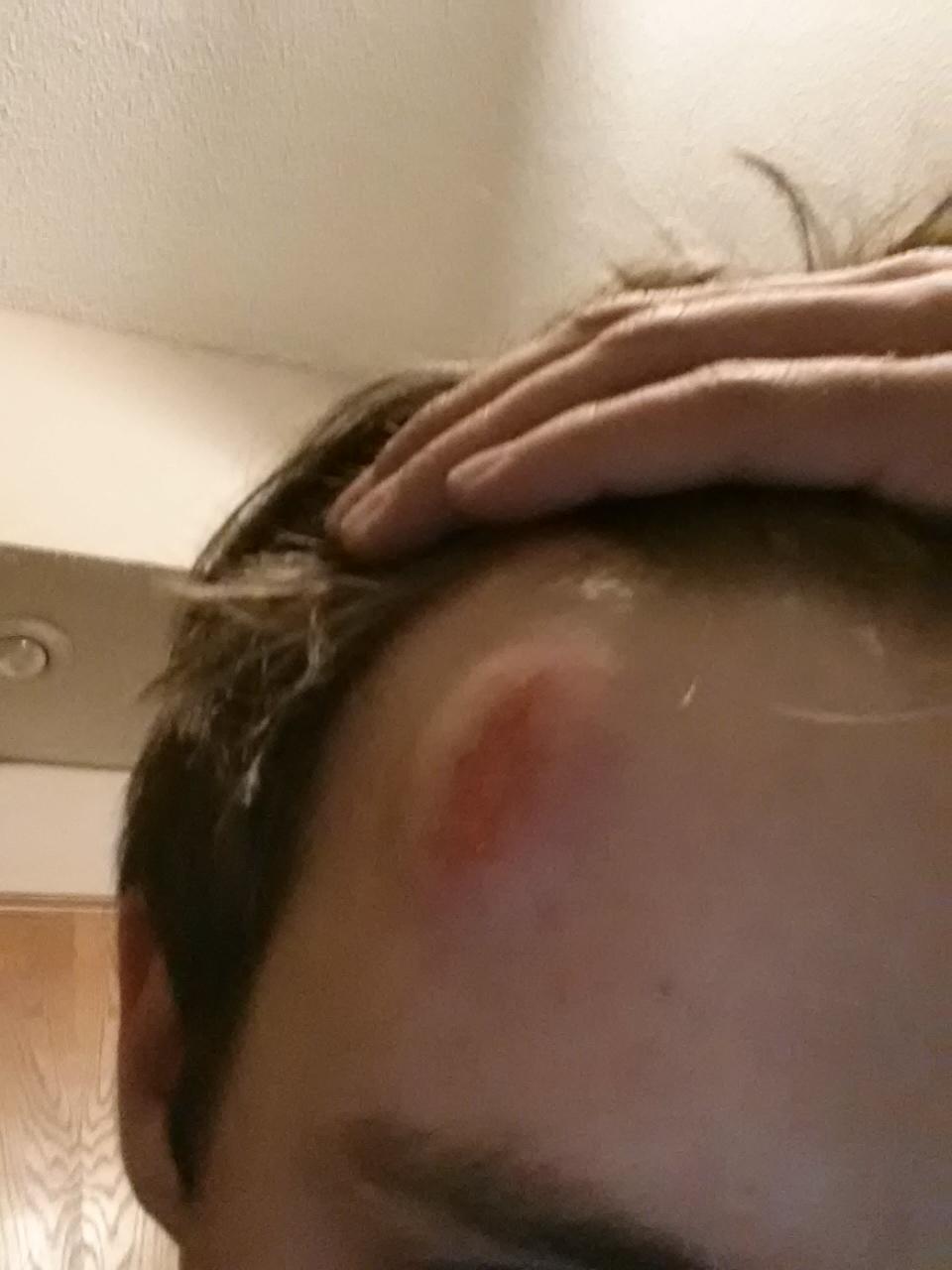
I detailed my accident thoroughly on Twitter, but in a nutshell, I was riding my old Raleigh bicycle when a white 2009 BMW M3 pulled in front of me.  We met at his quarter panel, I was sent up onto the hood, and my tailbone broke the fellow's windshield.  I hit the ground and had some scrapes and a nasty bump on my head, but for the most part I was okay.  As the adrenaline set in I was even more okay, and because the attending policeman never offered me a ride back to my apartment, I had to hobble home dragging my poor little Raleigh behind me.

Ow.
The next few days were extremely difficult, as every time I moved my body would ache and take my breath away.  It's amazing how much we use some of those little muscles in our lower backs, yet we never know until they're injured.  That was certainly the case with me despite my constant doses of Ibuprofen and intervals of ice packs.  Nonetheless, I healed up enough to walk with only a slight limp by the end of the week.  I still approached the thought of riding 14 hours in a car cautiously, as my tailbone had not been tested for such a long duration.  My fears proved unfounded, though, and my tailbone rarely disagreed with the long journey.

The journey to Austin and back is a wonderful story, but that will have to occupy another blog post.  For now I'll say that it went far better than I imagined, and we all got to see and do so many great things.  It was fantastic to witness Formula 1 in the flesh (er...carbon fiber) again, and the race also exceeded my expectations.  The circuit fits F1 very well, and all indications say that the city can hold its own, too.

After the Thanksgiving break it was back to school for the last push toward finals.  Needless to say that occupied most of my time.  Once on break I quickly adapted to doing nothing.  Such a transformation did not occur overnight, though.  After going 100 miles per hour for so long, it takes more than a day to settle down and come to a stop.  Predictably there were countless moments where I would consider what needed studying before embarking on whatever endeavor I chose.  I would feel terribly guilty for relaxing and doing nothing, and it took a while before I stopped.

In true "me" fashion this break has been quite busy.  I've been working on several projects, and I'll greatly miss them once I go back to school in a week.  One of these will necessitate its own post, and that's my go kart.  Again, if you've been following my Twitter (@WoodsiesGarage) you will have heard a great deal about this, but I got an incredible deal on a mini-Indy-style go kart that had been in a flood, and I've been cleaning it and piecing it back together.  I'll try to resume this project once I get back to school (since that's the town where the kart resides at the moment), and hopefully it will be running by the time it gets warm outside.

Another fun project has been the acquiring of my water pump for construction of a suction dredge/highbanker for gold prospecting.  With any luck I should be receiving the body for my sluice box tomorrow, so I'll try to post pictures.  I'm not too rushed in construction since I can't use it until spring anyway, but we'll see how it goes.

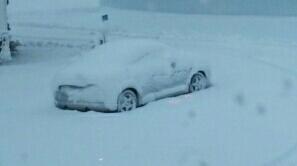
She's somewhere under that drift.
On another car front, I swapped the regular tires for snow tires on the TT a while back.  This was just in time for the car to be engulfed in an almighty blizzard, leaving it entombed in ten inches of snow for a week.  I finally dug her out, and now she's happily enjoying the warmer weather and diminishing snow.  With temperatures forecast to be in the 40s this week we should see most of the accumulation disappear, but I'll be leaving those snow tires on for a while, I'm afraid.

For now I think that's plenty of catch-up.  I have much to share in the ensuing posts (which I hope to create before I head back to school), so hopefully you'll enjoy reading it.  I'm sorry I haven't written more, but I'm trying to use my time to the fullest, including the break.  There is plenty more to come, though!

12 October, 2012

A relentless machine of studying, class and occasionally sleep

I'll start right now by apologizing for being aloof, but you must believe me, I would love nothing more in this world than to have the time to devote to updating you adequately.

In the weeks following my last blog post, I spent them up in The Garage working on the Maxwell, going on the Small Town Adventure and trying to do as many things as I could before summer ended.  My dream of finding an F1-related summer job didn't pan out, but I got to be the trackside reporter for every race at the Iowa Speedway, so that was fantastic.  Nothing like a Spa-Francorchamps or Suzuka, but it was fun nonetheless.  Plus when Indy came to town I got to be in my element.

As the only weekend of open-wheel racing passed at the Speedway, I got to interview Helio Castroneves and the eventual race winner Ryan Hunter-Reay.  I didn't know it at the time, but he would later go on to be this year's IndyCar champion---the first American in half a dozen years.

Then everything changed.  Orientation days.  Textbooks.  White coat fittings.  The works.  Med school began in a flurry for me, and while it started well, it has since become a relentless machine of studying, class and occasionally sleep.  The subjects are interesting, don't get me wrong, and the information is imperative to my success as a doctor someday, but one loses sight of such things with every passing day of six-hour study sessions.

Couple that with the fact that the work load is much greater than anything I've ever experienced in school, and it shouldn't be surprising that it's taking a while to get my sea legs.  If I were a sailor, though, I would have been kicked out of the Navy at this point for not developing those legs fast enough.  I won't lie, it's very difficult.  That's not to say that I can't do it, but often times I forget to tell myself that amidst the dissections, small groups, random assignments and weekly tests.

Along that same note, I talked to my great uncle Irvin on the phone today for about an hour.  His son is a doctor at the VA where Irvin, himself worked for many years.  His late daughter was a nurse there, and his other son is a doctor in my hometown.  I knew he might have some words of wisdom for me, and he didn't disappoint.  He told me stories of some of his doctor friends in the 1930s and of his son's difficult adjustment to med school in the '80s.  He spoke of the omnipresent geniuses that inevitably crawl out of the woodwork around the toughest test dates.  On and on we talked, and he helped remind me that there are worse things in life.

Just a year ago I was nervous about getting admitted to med school instead of completing it.  I was facing the prospect of a year of waiting to reapply, a year of boosting my resume and a year of paying for more school.  Instead of being faced with exams and projects, I may not have gotten in for another year.  I may not have gotten admitted at all.  This is what I wanted, as hard as it is to reconcile that these days.  I mention anything about that to my parents and it's always the same:  "It'll be worth it in the long-run."  That may be true, but it doesn't really help alleviate the stress or make a difficult concept any more tenable.  I appreciate their support, though, don't get me wrong.

But I digress.  As a result of school I haven't been able to work on any of my projects.  Heck, I don't think I've mentioned prior to this that I got a go-kart.  It needs a little engine work from a flood, but that's more than doable.  Plus it's a mini-Indy style kart that I'm planning to paint like Senna's old Lotus.  It will be so neat to get running, if that day ever comes.  God, I hope it does.

I haven't done a ton more to the Honda.  A leaky carb one weekend prompted the owners of my condo building to call me and ask if I knew anything about a leaky, smelly motorcycle in the garage.  I knew nothing of a leak prior to leaving, and I was just then hearing about it whilst driving down a country road literally two hundred miles away.  Awesome.  So I loaded the old girl into a truck and brought her back to my hometown where the local motorcycle mechanic took a look at the carb (those Japanese carburetors are beyond me).  He fiddled with it, replaced a seal, patted her on the rear and sent her back to me.  A fortnight later she was leaking again, so I'm leaning toward putting an external petcock halfway down the fuel line (as unauthentic as that will look).  I feel guilty, though; I haven't even started her in a month.  I haven't had the time to risk her leaking and losing another two gallons of petrol, so I just haven't tried.  Instead I've been riding the 'new' 1983 Raleigh cycle I received.

Since that was earlier in the semester, I had time to get the old Raleigh working.  She had a severely bent rear rim, so I had to replace that, put on a new tube and tire and figure out where an incessant squeaking was originating.  Some 30wt oil on the chain and into the pedals helped a ton, and now she runs silently and shifts smoothly.  I've been meaning to put my lock holder on for weeks, and the same goes for the rear light. I just put the front light on two days ago when I knew I would be riding home from a study session in the dark.  But in all, working on her has been fun.  I'm not terribly experienced in bicycles, but my motorcycle knowledge helps with that quite a bit.  I will admit, though, an occasional Google search may have helped, too.

I don't want to make this too terribly long, so I'll cut this short here.  I have plenty of other things to update, but I felt that after a long, difficult week (both in terms of studying and mentally) I needed to type something and get my mind off of school.  Writing and F1 have been the only things today that have been able to accomplish that feat, so why not?

Take care, all.  More to come, hopefully.

25 June, 2012

The time I spent just hitting this car with Thor cannot be overstated

Well today was certainly busy, but I wouldn't have it any other way.

I spent six hours in The Garage today working on the Maxwell brakes (and other projects on the side), and I couldn't be happier at the results.  So much has happened up there since my last post about the little Maxwell that I don't know where to start.

Last post I had just gone through the incredibly difficult process of getting the axle re-aligned and hooked back to the leaf springs.  I was aided by new U-bolts that were fabricated for free by some colleagues, and they ended up looking fantastic.  After the axle was hooked back on, now it was time to move onto the brakes, starting with the right rear (or the right, since there are no brakes on the front axle).

The first order of business was to remove the adjusting nut at the top front of the brakes.  The Maxwell had an ingenious system that takes all of two minutes to understand:  Rods connect the front brake lever to each of the rear brakes.  Where the rod comes in, there is a pivot point.  When you brake the car, it pulls the top of the brakes forward, squeezing the pads against the drum of the wheel (which, unlike modern drum brakes is inside of the pads).  Springs along a horizontal rod get compressed as that top moves forward, so when you're ready to let off, the brakes spring back to normal.  That's all there is to it, really.
The above is a picture from the rear center of the car looking outward.  You can see the pivot point in the center of the picture and the springs at the top.  The two pads are of some undetermined construction, so I'll have to do some checking to figure out what to use as pads.  Either way they're held on with brass rivets, so that shouldn't be a problem.

As you can also see above, I'd been dousing the moving parts of the brakes with penetrating oil every chance I got.  When I first began tinkering with the car long ago, nothing moved on the brakes.  By the time that picture was taken, I could pivot the arm and thus apply the brakes slightly, but there still was not much movement.

The first order of business would be to get the tire off---something I've never done on this car before.  I had attempted it long ago but soon gave up to go work on other things, as the wheel puller we have was not quite the right size to aid in the removal of this particular wood spoke wheel.

When taking the wheels off the Maxwell, first one has to remove the main lug nut and then a washer that comes off of the spindle.  From here, theoretically, with some force the wheel can be removed.  Not so easy in this case.

I bashed on the tire relentlessly for quite some time before attempting other methods (prying, wiggling, lubricating, etc.) until my father arrived home from work.  He bashed it a few times before recommending that we try hitting it a slightly different way.  The last time he had removed a wheel this old was when he was a young child and his father (the first Woodsie) restored a ~1903 Franklin.  Eventually we were successful, although the locking pin inside the wheel gave much sooner than I anticipated, thus injuring my leg as it leapt joyfully from the car.  This came after my father set a giant, super heavy mallet on the tire, only to have the tire rotate and send the enormous mallet crashing into my knee.

With the tire off I had an unabated view of the brakes like I'd never had before.  The scene did not look promising, though.  So much rust and so few moving parts meant that I would risk breaking a few old pieces if I struggled too much with them during removal.  With that in mind I gathered WD40 and a newly-discovered old can of PB Blaster, alternating use between the two on whatever part I needed freed.

I also tried my hand at mixing my own penetrating oil based on some wives tales I'd heard on the internet.  After gaining access to a new bottle of acetone, I found a 1980s bottle of automatic transmission fluid (ATF) and a 1960s Vlasic pickle jar in which to mix the two together.  Pouring my home brew over the parts, I soon found that the combinations of my three oils were actually loosening some of the rusted pieces.
I removed the brake adjuster (as seen above) and found that there were little swatches of the original blue paint still on it from 1910.  At the same time I also learned that this always-black piece (which I assumed in the past to be Bakelite) was actually brass!  I can't imagine how gorgeous it must look clean, but the aforementioned swatches tell me that it was once painted, so I may have to cover it in the end.
I used my grandfather's tap and die set to clean the threads on the adjusting nut and on the brakes as well (I love that set, by the way.  It always makes me so proud and honored to use it).  Then I scrubbed a little on the brakes themselves (seen below).  I soon realized that in order to make them work again I would need to take them entirely apart; as a result, my task just seemed a whole lot bigger.  I would begin by using the super large rubber mallet---which I now affectionately call Thor---to hit the brakes in every direction I could just to free them up.
After a while I could get the shoes to move inward and outward slightly, but not much.  Without the impediment of the wheel I could, for once, take a full swing when hitting the car.  I'm sure Thor loved this as much as I did.  Eventually I also spent some time hitting the pivot point (parallel onto the leftmost part of the spring in the above picture).  After a while this too could actually pivot and move for the first time in my life.  I soon realized that the little pin that held the threaded piece onto the arm would be a beast to remove, as would the one below it where the arm attaches to the rear brake pad.  Both would have to come out, though, if I hoped to get the thing working again.

The time I spent just hitting this car with Thor cannot be overstated.  I would work up sweat after sweat, spending five or ten minutes at a time repeatedly hitting different parts of this car and seeing them move millimeters at a time.  I would sometimes switch to the regular metal hammer before going back to Thor, but in the end I had always made a little progress.  If I combined my hitting episodes, though, I imagine I spent a few hours of my life hitting that car.  In the end, though, the arm would pivot easily and the springs would actually spring the arm back into place!  In essence, the brakes were extremely close to working!

I knew this was not good enough, though, and that the car needed to be done correctly, so I persisted.  I whacked the brake pads far enough apart that I could get the forward spring off the adjusting threads, then eventually I wiggled the pads enough to get the whole adjustment thread piece out of the center guide on the axle.  This meant I was free at the top of the brakes and had just one nut at the bottom to remove before the whole brake mechanism could come off the car.

In the meantime I tried hundreds of different ways to get those pins out.  I pried, I hit them, I grabbed them with vise-grips, I jammed different sized screwdrivers under their heads, I used a propane torch to heat the metal before hitting them and prying them and grabbing them some more.  On and on I went to no avail.  This was turning into the hardest part of the restoration so far.
The elements of my home brew of penetrating oil.
Part of the ongoing trouble was the fact that early on I planned on making my own pin-remover with a socket and a clamp, but the only clamp that we had was (1) old, as expected, (2) didn't have a rotating head on the threaded end, and (3) was not in the least bit square and straight.  As a result, when I tried to screw the clamp inward, it pushed itself off of the pin or off of the socket.  When I tried it the other way the old metal on the clamp would give way and the socket would gouge into it.

After some time I decided to move onto that bottom nut that would free the brake mechanism.  Oddly, this was incredibly easy to remove, which was a byproduct of soaking the whole thing in penetrating oil repeatedly.  And with that, I became the first person in 100 years to be holding the Maxwell's brakes in my hands, which was a pretty amazing feeling.

But this blog post is far too long as is.  There's so much more to talk about, but that will have to be in the next post.  In the meantime feel free to get (mostly) realtime briefs on Twitter at @WoodsiesGarage.  Thanks, all!

20 June, 2012

My interview with American GP3 driver Conor Daly: Barcelona, Force India and Hares!


American Conor Daly has been working his way up the racing ladder steadily for the past few years, but many more Americans took notice when the 20 year-old won the second of two GP3 races in Barcelona earlier this season.  Following that with a straight-line test for the Force India F1 team before heading to Monaco, Daly’s first full year in GP3 has proved to be a busy one, but I caught up with Conor for a candid interview about this whirlwind of a year shortly before the Monaco round of the GP3 championship.


Daly, the son of former CART and Formula 1 racer Derek Daly, is a former World Karting Association champion and multiple winner in Skip Barber and Formula Ford.  Originally entering the Road to Indy, which aims to aid racers in ascending to the IndyCar series, Daly won the Star Mazda Championship in record-setting fashion in 2010 (nine poles and seven wins) before moving on to Indy Lights the following year with Sam Schmidt Motorsports.  After capturing victory in Long Beach, Daly competed in GP3 with Carlin Motorsports (splitting his season between Europe and the United States).

But throughout all of these accomplishments, Daly has perhaps garnered the most attention in just four races in GP3.  Currently fifth in the championship standings with 23 points, Daly won the Barcelona sprint race on the opening weekend of the GP3 season, but it wasn’t easy.


What many people didn’t realize was that Daly had already been offered a spot testing the Force India before the opening weekend of the GP3 season---something he called “a nice little incentive” for those first two races.  However, that didn’t make things simpler for him in the feature race.

After a great qualifying, Daly dropped several spots at the start, from which he was never able to recover.

I saw the pole sitter, [António Félix] da Costa jump and I released the brake just slightly which made me pull in the clutch paddle so when the lights actually went out I was slipping the clutch way too much,” Daly said.  As a result the car stayed relatively stationary before creeping away slowly.  Despite the disastrous start, the clutch had only been slipping for a total of 2.4 seconds.  “It was definitely my fault, and it was sad because I was in a good position to try and win but unfortunately I wasn't able to do so,” he lamented.


Over the course of the race a difficult battle with Marussia Manor Racing’s Tio Ellinas developed until a late safety car bunched the field together.  In the ensuing sprint to the end, Daly’s main focus was finishing the race in one piece and setting himself up for the sprint race, which would invert the top eight finishers from the feature.  He would go on to finish P6, which meant he would start P3 on the inverted grid for the sprint finale.

More jump starts saw penalties befall those in front of him, and the sprint race quickly became a one-man show with Daly pulling away.  He later revealed that in the final few laps he had to keep himself from thinking too much about what would happen if he won.  Instead he made himself concentrate more.

The car was so good that I was able to focus on hitting my marks and just finishing out the race,” he said.  “I had to manage the tires towards the end and was able to finish with a good gap behind me so I was quite happy.”

 One of the best moments of the weekend for American fans was seeing Daly holding the American flag as he celebrated in parc ferme after the race.  Where did the flag come from, though?


 “I made sure to have my Dad bring the American flag from home because I knew I would get to use it at some point this year, I just didn't honestly think it would be this soon!  I was so thrilled to hear the American national anthem.   It was a very emotional moment and I can't really describe the feeling I had.  I was relieved because I knew that I was starting to prove myself in Europe.  I was extremely happy but it’s just the beginning and I can't wait to get to the next race in Monaco!”

For the rest of the weekend the young American was approached by numerous luminaries of the GP3, GP2 and F1 worlds.  At one point he was even congratulated by Ferrari F1 team principal Stefano Domenicali---the importance of which was not lost on the Indiana native.


“It is always nice to know people are watching,” Daly smiled.  “I don't want to get too caught up in it, though, because it’s a long season and I just want to focus on keeping the good finishes coming and scoring points to be there for the championship at the end.”

I have to ask, then, are any future deals coming out of some of those important conversations?

Daly laughed.  “Not that I know of at the moment!”

Fast forward to the Force India test a few days later. This was Conor’s first taste of a Formula 1 car.  Obviously he had grown up hearing about the machines, but the jump between GP3 and F1 technology had to be a great one.


 “They are indeed massively different cars.  The F1 car was absolutely incredible.  I was pretty much living every childhood dream I ever had!  There are just so many different settings on the steering wheel and it is a far more technically advanced race car than anything else in the world,” he explained.

But the coolest thing, if he had to choose something?

“Ultimately, though, the coolest thing had to be the sound under hard acceleration; just absolutely beautiful.

Since the test was a straight-line test---one of the few types of testing that has been allowed by the FIA over the past few years---Daly had plenty of opportunities to accelerate and decelerate, sometimes being told to accelerate as hard as he possibly could (which he described as being “the best part” of the session).  There was a brief moment, however, when he got to test out the handling as well.


Somewhere around 150 mph a hare ran out onto the Cotswold Airport runway where Daly was testing (located in Gloucestershire, England).  Although it wasn’t as much of a near-miss as some would like to think, Daly said he ‘did have to make his way around [the hare] as it sprinted away.’

Surprisingly, having worked with the Lotus GP3 team and now Vijay Mallya’s F1 team, Daly says that the two squads are extremely different, but only because the Lotus GP3 team is really ART GP.

“It's funny because everyone thinks because we have the same name that we are heavily affiliated with the Lotus F1 team but really we aren't,” he explained.  “Lotus GP is really ART GP which has been one of the best teams in the world competing in junior formula car racing.  Fortunately, though, the [ART GP] team has aligned themselves with the Lotus F1 team which gives us the cool color scheme and a great historic name.”


 Even so, Daly says with a chuckle that he is yet to meet anyone from the Lotus F1 team.

From there Conor was going to be heading to Monaco---somewhere he had never raced but had always dreamed about experiencing.

“I have been looking forward to this race since it was announced on our schedule.  I love street courses,” he said.  “I have raced on many street courses in America, and I've thoroughly enjoyed every single one.  Now I get to race on what is arguably the best street course in the world!”

Citing the 27 cars that will be taking part in the race, Daly noted that he may need a little luck when it comes to avoiding the inevitable traffic jams, but through simulator work and studying the track, he felt very comfortable leading up to the race.  He even mentioned that he was most looking forward to “pushing the limit in qualifying and using every inch of the track to try and get the pole.”


So, with one victory in the first two races, Daly would head to the French Riviera to the legendary and dangerous streets of Monte Carlo, where few could have predicted the outcomes of that weekend’s races.  We’ll catch up with Conor and get his thoughts on Monaco and the following round of the GP3 championship (Valencia, Spain) next time.

25 May, 2012

The Magic of Monaco

As we get ready to begin the most important weekend of the motor sports calendar, who can blame me for being too excited to sleep?  Aside from watching the Indy 500 on Sunday, I plan on getting up tomorrow morning at 4am to watch the final Formula 1 practice from Monaco, going back to sleep an hour later, then getting up at 7am to watch qualifying.  Such is the difficult life of a die-hard American F1 fan, but you certainly will not hear me complaining.  Quite the opposite, actually.  I'm thrilled to do it.  I'm beyond ecstatic to witness every moment I can from the Côte d'Azur, whether it be over the internet, television or Twitter.  Why does this Grand Prix get my heart racing more than any other (possibly excluding Spa), though?

There are many reasons to count against Monaco for being an awesome race to watch.  Some past races have been outright boring.  The track is as narrow as the room I'm currently occupying, and overtaking is supposedly impossible.  At less than two miles per lap, the circuit is far from modern F1 venues in both circuit length and safety, and the cars barely average 100mph over those 2.075 miles.  What makes the Monaco Grand Prix so fascinating, then?

I'll start with my background to the race.  As I've mentioned before, I was first introduced to the sport by my father who had been a passive fan since the 1950s (in the early days the occasional "Wide World of Sports" was the only F1 exposure Americans like him received).  The first race he ever saw covered on American television, broadcast in black and white on the television in his childhood home, was the Monaco Grand Prix.  He remembers seeing Stirling Moss and Graham Hill climb the podium over the ensuing years.  He remembers the early days of the tunnel and the many names of the hairpin.  He also remembers the cars that landed in the harbor ten years apart as well as the horrific death of Lorenzo Bandini broadcast live, the flames of his boiling Ferrari fed by the wash of the television helicopter's blades.

My father has seen a little of everything over the years, and he thought it was my turn.  He woke me up early one Sunday morning because he thought I would appreciate the technical nature of the sport and the extreme talent of the drivers.  That morning was the Monaco Grand Prix, barely a few laps old.


Of course I had no knowledge of the drivers, the location or the history of the race, but I was beyond awestruck.  I won't go into why I was blown away by the sport (I could fill a long blog with that), but part of the allure was this whimsical location:  A tiny principality situated on the French Riveira, the epitome of old world opulence and modern glamour, contrasted by these sleek, sexy hypercars that seemingly defied physics.  Seeing the cars blast past the historic casino or traverse the harborside, meters away from the Mediterranean was something so alien from any other form of racing.  I was immediately hooked.

As I've come to immerse myself in every aspect of Formula 1, one facet that I cannot overlook is history.  Always a fan of the tradition, stories and ghosts that surround such events, Monte Carlo has a bit of everything.  The race has been run on virtually the same roads since 1929, which isn't hard to discern through the grainy footage of those early Monaco Grands Prix.  The track was a treacherous one when it was first defined.  Its mixture of road surfaces and vulnerability to the Mediterranean's changing weather was a perfect way to test cars and drivers alike, and even 80 years ago there was little room for error within its narrow streets.
As the cars grew faster and the principality thrived, the face of the Grand Prix changed in some ways.  Racing was dangerous, the drivers were a mix of aristocrats and mechanics, and Monaco soon gained importance in the international motor sports scene.  One could see a little bit of everything in this tiny principality's races.  By 1936 the race was a part of the European championship and helped pioneer the use of lap time-based qualifying (rather than the balloting procedures used in the early races).  The Regenmeister Rudy Caracciola won that year for Mercedes-Benz.

By the official start of the Formula One World Championship, it saw Juan Manuel Fangio secure his first F1 win (in 1950, and he would win again later that decade).  Stirling Moss, the British legend, won three times on the Monte Carlo streets, although an overall Championship always eluded him.  Jackie Stewart won thrice here, too, as well as a slew of one-off victors whose racing immortality was wrought by the twisty streets of the Monegasques.


The statistics that always sit in my mind, though, are the drivers who have won at Monaco more than any others---a virtual "Who's Who" of timeless champions.  Only a dozen drivers in history have ever won here more than once.  Alain Prost earned four Monaco wins during the 1980s.  Almost a third of two-time World Champion Graham Hill's F1 victories came here; his record five wins earned him the nickname "Mr. Monaco," although others merely called him "The King."  His record stood for decades, and is now tied by seven-time World Champion Michael Schumacher (who, shockingly at the time, did not win the first Monaco race I ever watched).  For me, though, the jaw-dropping statistic that resonates is the number of times Ayrton Senna found the top step of the podium here:  Six.  That record includes five straight victories, only broken one year by Prost.

I found it very interesting hearing Michael Schumacher talk this weekend about his memories at this circuit.  He was asked about his favorite moment, and the first that came to mind was in 1994.  It was that year, he reminisced, that he first experienced "flow" in a race car---the otherworldly moment when you lose consciousness of the world around you, when every inch of the car's carbon fiber skin becomes an extension of your own.  It was in Monte Carlo that he first experienced it, and he'll never forget that moment.


This may bring back the words of Senna from years before, popularly known nowadays for the voice-over they provide during his pole laps in qualifying.  He spoke of the spiritual moment when he was no longer driving the car with effort, it was just happening.  It was automatic and flawless.  Few drivers truly experience this, although many will claim to have tasted it briefly.  For those who are genuine, the fickle circuit rewards them greatly.

This is another aspect of the race that fascinates me.  To succeed at Monaco, you have to be perfect.  Any incapacity, carelessness or neglect will be punished by the guardrails that now patrol the circuit's extremities. The corners approach so quickly that a driver can never afford to be "behind the car" as he drives.  The incessant bumps and greasy pavement require the utmost feel for the car and management of the tires.  And the layout demands entirely new parts to be machined in European factories and baked in multimillion-dollar autoclaves.
If anything, the challenge of the Monaco Grand Prix seems perfectly suited to test the F1 circus.  Remember, though, this is a track that is relatively unchanged since 1929.  Eighty-three years ago, Grand Prix planners had no notion of downforce, 700+ horsepower and carbon fiber.  The track was designed to test the drivers and cars of that age.

Somehow the ingredients were just right.  Somehow a race was created that was perfect enough to throw the biggest of loops at the cars and drivers of yesterday and today.  Yes, the circuit in Monte Carlo is extremely out of place compared to the rest of the F1 calendar, but the Grand Prix is a welcome anachronism that exists outside of the rest of Formula 1's guidelines and norms.  It's the perfect mix of high society, the latest technology, plenty of prestige and history.  Drivers may win on brand new $1 billion circuits in faraway lands where speeds reach 210mph, but every driver out there would give it up for a win in  the narrow streets of Monaco.  To reach the top step of the podium here (where you will receive your trophy in the royal family's skybox) means you have tested your mettle and supreme driving talent and have been deemed worthy by the racing gods.  Your name will forever rest beside Senna, Schumacher, Hill, Fangio and others under the heading of "Monaco Grand Prix winners".  Simply put, there's nothing like it in Formula 1 or anywhere else in motor sport.

17 May, 2012

And just like that, the plucky, rusty little Maxwell had its rear axle back

There's nothing quite like the advent of summer when I get to wake up on my own accord, throw on some ratty clothes and head up to The Garage to work.  I'll take a pop or two to drink, turn on the Oldies and wander around doing whatever job catches my fancy.

To start this summer, which is the first in ages where I'm not taking a class or needing to be in another city, I've already spent two days exclusively up in The Garage working on the Maxwell.  I have a long list of things I want to accomplish this summer up there, but the Maxwell is first on the list.  Over the last 48 hours I've probably spent eight or more up there squatting down behind the Maxwell formulating a plan, hitting it or spraying it with WD40 (I'll explain shortly).

Yesterday I started things off by inspecting the new U-bolts the gentlemen at my dad's workplace made for the car.  They used a couple of the broken off originals to fabricate new ones out of incredibly durable grade-8 bolts, and I must say, I'm extremely impressed with their work.  The old ones are on the right in the picture, and one of the original square nuts is sitting among all the new ones.)  I was apprehensive about how they would fit, and after trying to put them on, my fears were confirmed.  Three of the four refused to sit down over the leaf springs, and bashing the heck out of them with a hammer wasn't working.  First off, there was absolutely no room under the car to get a backswing when I wanted to use the hammer.  Second, even when I could made contact with the new bolts, nothing would happen.  They would wiggle one way and go down slightly, then they'd wiggle another way and raise back up slightly.  It was maddening.

After trying various implements of destruction for a while, I grabbed some oversize washers and managed to get the newly-fabricated square bolts started on a couple of the threads.  Using the longest wrenches I could find, I grunted and pushed against the whole car until I managed to get the U-bolt pulled down slightly.  I then put the other side's nut on and tightened that.  Alternating back and forth I eventually got all of the U-bolts down.  As you can see in the picture, they contrast quite clearly with the rust and with the leaf springs that I've already primed.  I let them sit for a few weeks to relax a little since I was needing to finish the school year anyway and wouldn't be back to work on them until summer.

The problem yesterday was the fact that the threaded areas (I'll call them legs) of the U-bolts weren't even close to lining up with the holes on the axle.  That's not good.  I precariously balanced the axle on our old two-ton jack and slowly raised it off the ground where it's been sitting for nearly a year.  It was quite apparent when I got the axle up to the bottoms of the legs that this was going to be far from easy.  I mentioned on Twitter (@WoodsiesGarage) that this probably wasn't going to be a quick job, and sadly I was right.

I sat back and stared at the car for quite some time contemplating what to do.  I could maybe get a couple of the holes to line up, but as I jacked it up farther, it would push the U-bolts that weren't lined up off of the leaf springs.  I'd be back to square one with them.  I proceeded to try a few different, wild ideas to get them right.  I hit them with rubber mallets, with regular hammers, with wrenches, I tried to pry them sideways, on and on.  Eventually I got the left rear one to line up (you're looking at the right side in the picture above, so the one on the right is what I'm considering "front") and got the bolts on.  That put me a little closer with the four on the right side, but still not quite.

I began pulling on the axle in every different direction, often to the point of rocking the car almost off of its stands.  Soon I had a couple of the right side legs lined up, one of which was even extending through the axle hole.  I could just barely get a nut on it, so I then employed a potentially injurious method of using two large wrenches hooked together to get more torque.  Slowly but surely the bolt pulled down, and soon I was able to get it tightened.  I then got the front right tightened the same way (only smashing my hand a few times as the wrenches slipped), but the left front U-bolt was eluding me.  Unlike all of the rest, this U-bolts legs spread outward instead of going straight downward, meaning I'm about half an inch off of the holes.

After trying various methods of squeezing them together, I bashed the U-bolt a thousand times and managed to get it to pop off the leaf springs.  Putting a bolt on each leg so as not to damage the threads, I then squeezed the thing in the vice to close the legs together.  My dad arrived to make sure I was still alive and took the U-bolt to grind on the inside.  After nearly burning his hands on the hot metal, we had ground and bent enough so that the bolt slid right over the leaf spring and fit perfectly!  And just like that, the plucky, rusty little Maxwell had its rear axle back.
Look Ma, no jacks!  The axle is hanging perfectly!

I think that's probably good for this post.  More to come about my activities today, but that will come later.  Ah how wonderful it is to get back in The Garage again!